Vocabulary games

Vocabulary Games for Adults & Students

The vocabulary games that actually build word knowledge make you recall a word or its meaning, use it in context, and see it again days later through spaced repetition. Definition matching, fill-in-the-blank, crosswords, root-building and Taboo-style describing games do all three; pure speed or letter-spotting games mostly exercise words you already know.

Below are 14 games you can play with paper, cards, or friends, each mapped to the WordFren mode that does the same job on your phone.

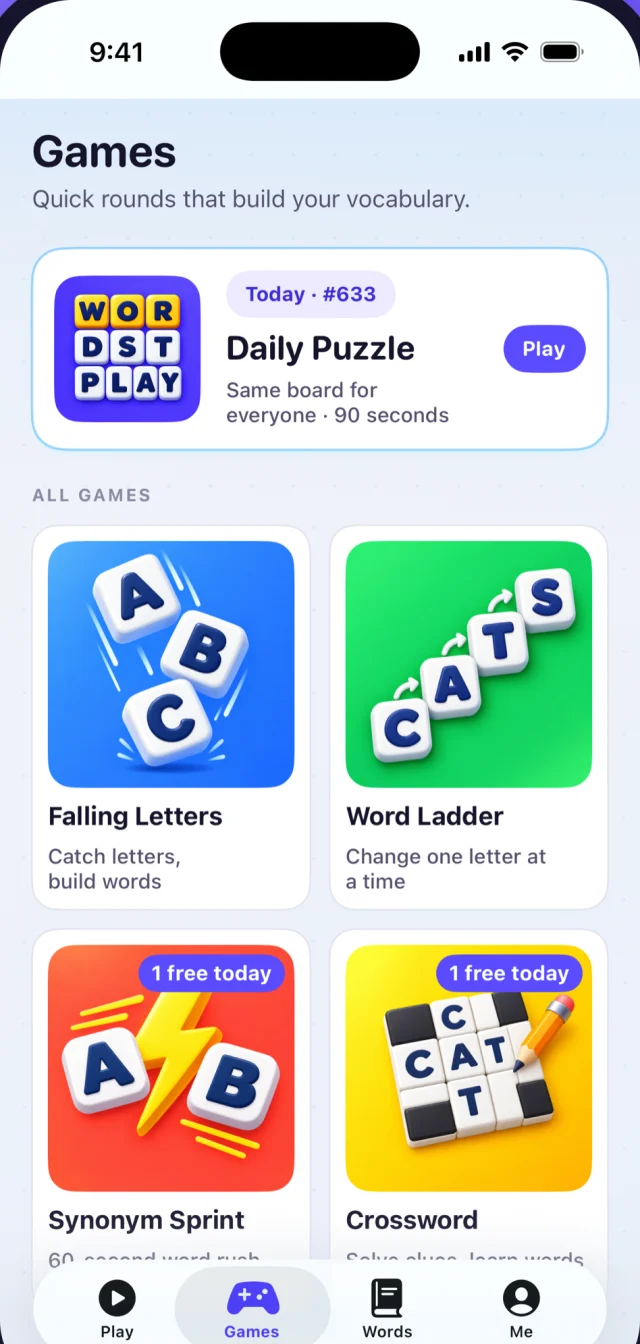
WordFren Games tab listing vocabulary games

Learn new words

Fictionary, root builder, Rare Discovery

Make words stick

Definition Match, fill in the blank, describe-it

Use words precisely

Shades of meaning, synonym sprint, crosswords

14 vocabulary games that build real word knowledge

Each game lists what it trains, how to play it with no app, and the WordFren mode that does the same thing in a few minutes a day.
  1. #1 · Like Concentration / memory pairs

    Definition Match

    Trains: Word-to-meaning links and fast recognition

    How to play: Write eight words and their definitions on separate cards, shuffle face down, and flip two at a time. Keep a pair only if the word and meaning match. Say the word in a sentence to bank it.

    In WordFren: Definition Match. Match words to meanings on a timer, using words you've already found.

  2. #2 · Like Balderdash / the dictionary game

    Fictionary (bluff the definition)

    Trains: Curiosity about rare words, word roots, and precise definitions

    How to play: One player picks an obscure word from a dictionary and writes the real definition. Everyone else writes a convincing fake. Read all definitions aloud; players vote for the real one. Points for fooling others and for guessing right.

    In WordFren: Rare Discovery. Find an uncommon word, then read its real meaning and example sentence.
  3. #3 · Newspaper or themed mini crosswords

    Crosswords

    Trains: Retrieval from a clue, spelling, and synonyms

    How to play: Start with small 5x5 or themed puzzles so you finish often. When a clue stumps you, look up the answer afterward and note the word and clue together; that pairing is what builds recall.

    In WordFren: Crossword. Solve short clue-based puzzles and learn each answer's meaning.
  4. #4 · Lewis Carroll's “doublets”

    Word Ladder

    Trains: Spelling patterns and awareness of how many real words are nearby

    How to play: Pick a start and end word of the same length (COLD to WARM). Change exactly one letter per step, and every step must be a real word. Shortest ladder wins.

    In WordFren: Word Ladder. Change one letter at a time to reach the target word.
  5. #5 · Like Boggle

    Letter grid word hunt

    Trains: Word formation, spelling, and speed of retrieval

    How to play: Lay out a 4x4 grid of letters. In a set time, list words made from adjacent letters. Cross out words other players also found; unique words score. Look up any word you weren't sure was real.

    In WordFren: Daily Puzzle. One shared board a day, the same for everyone. 90 seconds to find words and chain combos.
  6. #7 · Like Scrabble or Bananagrams

    Letter tile building

    Trains: Spelling, word formation, and a bigger bank of short words

    How to play: Draw seven letter tiles and build the longest real word you can, or connect words on a shared board. Keep a “new words” list of anything an opponent played that you didn't know.

    In WordFren: Falling Letters. Catch falling letters and build words before they land.

  7. #8 · Prefix + root + suffix cards

    Root builder

    Trains: Morphology: decoding unfamiliar words from their parts

    How to play: Make three piles of cards: prefixes (un-, re-, bene-), roots (dict, port, spect), and suffixes (-able, -ion). Combine one from each pile into a real word, then explain its meaning from the parts.

    In WordFren: Word Forge. Build words from roots and see how the parts create meaning.
  8. #9 · Timed thesaurus race

    Synonym sprint

    Trains: Word variety, nuance, and speed of retrieval

    How to play: Call out a common word like “happy”. Everyone has 60 seconds to write as many synonyms as they can. Score only words you can use correctly in a sentence.

    In WordFren: Synonym Sprint. A 60-second rush to find words with the same meaning.

  9. #10 · Last-letter chain (like Shiritori)

    Word chains

    Trains: Fast retrieval and breadth of vocabulary

    How to play: Say a word; the next player says a word starting with its last letter (plant, tiger, radiant…). No repeats, five seconds per turn. Add a theme, such as only adjectives, to make it harder.

    In WordFren: Word Chains. Chain words by their last letters against the clock.
  10. #11 · Cloze sentences

    Fill in the blank

    Trains: Using words in context, collocations, and grammar fit

    How to play: Copy sentences from something you're reading and blank out one word. Swap with a partner and fill each other's blanks. Discuss when more than one word works, and why.

    In WordFren: Context Match. Pick the missing word that fits the sentence.
  11. #12 · Near-synonym sorting

    Shades of meaning

    Trains: Nuance: choosing the exact word, not just a close one

    How to play: Write near-synonyms on cards (warm, hot, scorching, sweltering) and line them up from weakest to strongest. Then write a sentence where only one of them is right.

    In WordFren: Context Clash. Tell similar words apart in real sentences.

  12. #13 · Like Taboo or Catchphrase

    Describe it without saying it

    Trains: Active recall from a meaning, and defining words in your own words

    How to play: One player sees a target word and describes it without using the word or its obvious relatives. Their team guesses. Pull the target words from a list you're learning.

    In WordFren: Recall. See a sentence and produce the word that fits, with spaced review bringing it back.
  13. #14 · Like Charades or Pictionary

    Act it out or draw it

    Trains: Deep, memorable encoding of a word's meaning

    How to play: Write vocabulary words on slips. Players act out or sketch the meaning while teammates guess. Abstract words (reluctant, meticulous) are harder and more memorable than objects.

    In WordFren: Your Words. Your saved word library makes a ready-made deck of words to act out.
Free in your browser

Play a round right here

This is Definition Match: tap a word, then tap its meaning. Matching forces you to retrieve what a word means instead of re-reading it, which is the part that makes words stick. In the app, the words come from your own library and come back for review before you forget them.

Try one right now

Tap a word, then tap its match.

Pick games for who's playing

Vocabulary games for adults

Adults rarely stick with flashcards, but they do stick with a daily ritual. Choose short games with grown-up words and a reason to come back: a shared daily puzzle, a crossword with coffee, or Fictionary at game night.

  • • 90-second Daily Puzzle, same board for everyone
  • • Crosswords and Word Ladder for a quiet break
  • • Context Clash for precise, professional word choice

For students and test prep (SAT, GRE, ESL)

SAT and GRE questions test words inside sentences, so favor context and nuance games over pure definition drills. ESL learners get the most from matching, cloze sentences and describing games built on everyday words.

  • • Word lists: SAT, GRE, everyday English
  • • Context Match and Recall for in-sentence practice
  • • Word Forge to decode unfamiliar words from roots

For classrooms and families

Group games work best when everyone can join in with no setup. Run a five-minute warm-up, reward interesting words and correct usage rather than speed, and finish by writing one sentence with a new word.

  • • Fictionary, charades and describe-it for groups
  • • Word chains for car rides and lines
  • • Compare Daily Puzzle scores at the dinner table

How to choose a vocabulary game

Plenty of word games are fun without teaching much. Before you commit, check for these five things:

  1. 1

    It introduces new words

    If every word is one you already know, you're practicing speed, not vocabulary.

  2. 2

    It makes you recall, not just recognize

    Producing a word or meaning from memory builds stronger memories than spotting it.

  3. 3

    It shows words in context

    Sentences teach how a word is actually used, including what it pairs with.

  4. 4

    It brings words back later

    Reviewing across days (spaced repetition) is what turns a new word into a known one.

  5. 5

    You'll actually play it daily

    Short and fun beats thorough and skipped. Five minutes every day adds up.

Want the research behind this? Read why word games build vocabulary and how spaced repetition works.

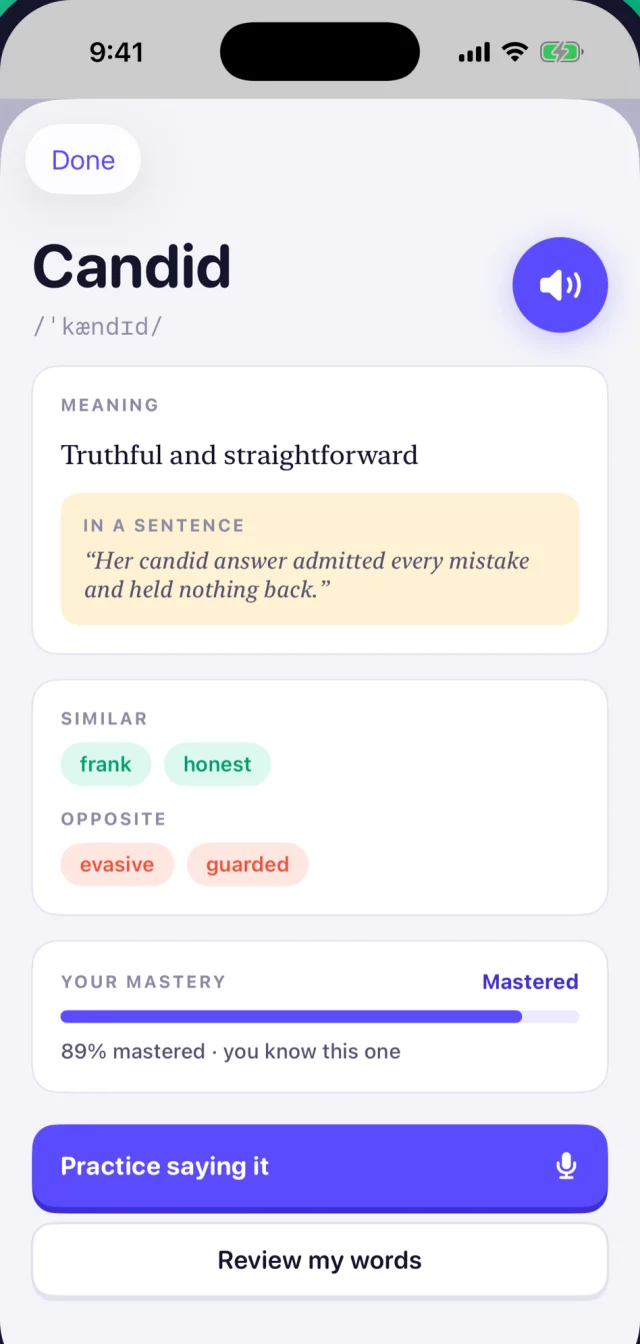
WordFren word detail with meaning, example sentence and mastery bar

Vocabulary building apps compared

An honest look at popular options. We make WordFren, so weigh our take accordingly; the right app is the one that matches your goal and that you'll open every day.

AppBest forApproachTrade-off
WordFrenAdults and students who want daily word games that feed a review systemFree iOS app. A shared Daily Puzzle plus a Games tab (Definition Match, Crossword, Word Ladder, Synonym Sprint and more). Words you find go into a library with meanings, example sentences, and spaced review.iPhone only. Pro removes ads and unlocks extra perks.
Vocabulary.comStructured English vocabulary study, especially in schoolsWeb-based (with mobile apps) adaptive question practice and a large dictionary. Widely used by teachers, with word lists and classroom competitions.Feels more like quiz practice than a game.
DuolingoLearning a new language, including English for non-native speakersShort gamified lessons with streaks and leagues. Vocabulary is taught inside grammar and sentence lessons.Not designed to expand an adult native speaker's advanced English vocabulary.
ElevateGeneral brain training across reading, writing, speaking, and mathA set of short skill games, several of them focused on word choice and vocabulary.Vocabulary is one area among many, not the main focus.
Word of the Day appsLight, low-effort exposure to new wordsOne new word a day with a definition, often as a notification or widget.Mostly passive reading. Without recall practice, most words fade.

More head-to-heads: WordFren comparisons.

Vocabulary games FAQ

What are the best games to improve vocabulary?

The games that build vocabulary make you produce or choose a word from its meaning or context, not just spot letters. Definition matching, fill-in-the-blank (cloze) games, crosswords, Fictionary, root-building games and Taboo-style describing games are strong picks. Pair any of them with a way to review the new words a few days later.

Do vocabulary games actually work?

They work when they include retrieval practice (recalling a word or meaning), meaningful context, and review spread over days. A game that only rewards speed with words you already know is fun but adds few new words. Check that a game introduces new words and brings them back later.

What are good vocabulary games for adults?

Adults tend to stick with games that are short, a bit competitive, and use sophisticated words: daily shared puzzles, crosswords, Fictionary with friends, and synonym or context games. WordFren's Daily Puzzle takes 90 seconds and the same board is shared by every player, which makes it easy to keep as a daily habit.

Which vocabulary games help with SAT, GRE, or ESL prep?

For SAT and GRE, use context and nuance games (fill-in-the-blank, shades of meaning) with a test word list, because those exams test words in sentences. For ESL learners, definition matching, picture or charades games, and cloze sentences built from everyday English work best.

What is the best app for vocabulary building?

It depends on your goal. WordFren suits people who want daily word games tied to spaced review; Vocabulary.com suits structured, school-style study; Duolingo is best if you're learning English as a new language; Word of the Day apps are fine for light exposure. The best one is the one you'll open every day.

How long should I play vocabulary games each day?

Short, daily sessions beat long, occasional ones. Five to fifteen minutes a day, plus a quick review of the words you saved, is a realistic routine that fits spaced repetition.

What are fun vocabulary games for the classroom or family?

Fictionary, Taboo-style describing, charades with vocabulary words, word chains, and a shared daily puzzle where everyone compares scores all work in groups with no special equipment. Reward interesting word finds and correct usage, not just speed.

Are there free vocabulary games?

Yes. Every classic game on this page can be played free with paper, a dictionary, or cards. WordFren is also free to download on iPhone, and you can play a round of Definition Match on this page in your browser.

All 14 kinds of practice, in one free app

WordFren turns vocabulary games into a daily habit: a 90-second shared puzzle, a Games tab full of word modes, and spaced review so the words you find stay found.

Keep exploring: learning guides, vocabulary topics, free word tools.